
Reviewed · WALKING TOURS
Free City Walking Tour in Oslo
Oslo reveals itself quickly on this 90-minute city walk, moving from the Tiger statue through the waterfront, old town, fortress, civic center, theater district, and royal quarter. You get a useful first look at the Norwegian capital without spending a full day indoors or crossing the city by bus.
I like the strong central route, which links the Opera House, Akershus Fortress, Nobel Peace Center, City Hall, University Aula, Royal Palace, and Parliament. I also like the human touch: guides including Zoe, Nicholas, Nikola, Yellena, and Mia bring different stories and personalities to the walk. The main consideration is pace. There is a fair amount of walking, and one less enthusiastic account found the talk too light, so this suits you best if you want a brisk introduction rather than a long historical lecture.
Key points to know before you go
- The route covers Oslo’s central highlights: You see major landmarks from the waterfront to Parliament in about an hour and a half.
- The Tiger statue is an easy meeting point: It stands by Oslo Central Station at Jernbanetorget, close to public transportation.
- Akershus Fortress adds the best viewpoint: The walk includes the castle grounds and a story connected with Alfred Nobel.
- The guides focus on stories, not just buildings: Expect local history, royal anecdotes, Norwegian culture, and everyday life.
- The advertised price is low, but budget for a tip: The booking price is listed as $3.45 per person, while one review says tips of about $10 per person are expected.
- The group may be sizeable: Up to 30 people can join, which keeps the price down but may make it harder to ask one-on-one questions.
Starting under the Tiger at Jernbanetorget
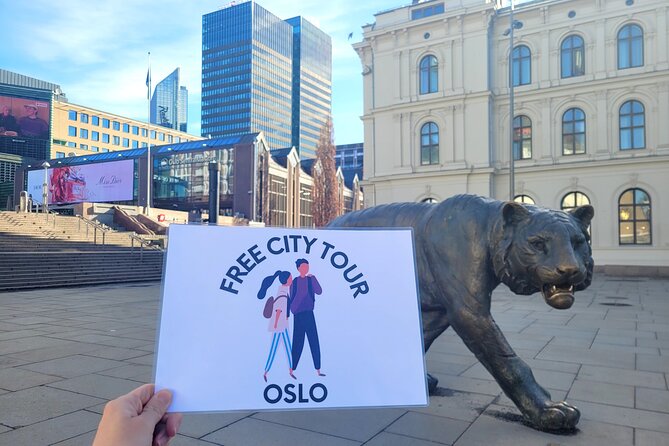
The tour begins at The Tiger, Oslo’s well-known sculpture outside Oslo Central Station. This is a practical meeting place: it is easy to find, close to public transportation, and near the city’s main pedestrian routes.
The opening eight minutes are not really a sightseeing stop in the usual sense. They give the guide a chance to gather the group and set the tone. Since the group may include around 30 people from many countries, pay attention at the start and stay close enough to hear.
This is a good tour to take near the beginning of your stay. You will get a simple map in your head: waterfront in one direction, the fortress and old town in another, then the civic and royal buildings along or near Karl Johans gate. That basic orientation can save time later.
The guides appear to bring different styles. Nicholas is described as offering a local view of history and daily life. Nikola received praise for explaining each point at an unhurried pace, even in chilly weather. Yellena was noted for being fun and friendly, while Zoe was described as personable and easygoing. Mia is also named as a guide who shares appealing places around Oslo. Your guide will depend on the departure, but the range of names suggests a team rather than one fixed personality.
Other guided walks in Oslo:
- Oslo Nature Walks: Island Hopping Tour
★ 4.8 · 2,713 reviews - Oslo Nature Walks: Island hopping
★ 5.0 · 570 reviews - Oslo: Best of Oslo Walking Tour
★ 4.5 · 458 reviews
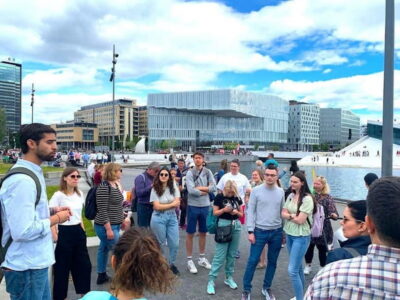
Oslo Opera House and the Bjørvika waterfront
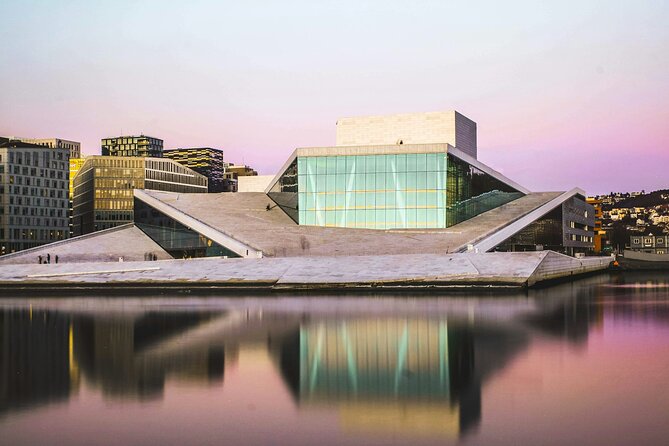
The walk then heads toward the Oslo Opera House, with about ten minutes devoted to the building and the nearby Bjørvika area. The route also brings in the Public Library, Munch Museum, and Sørenga.
This part of Oslo shows how much the city has changed around its harbor. Rather than presenting the waterfront as a single monument, the guide connects several modern cultural buildings and public spaces. You get a sense of how Oslo uses the shore for art, reading, museums, housing, and open-air strolling.
The Opera House is one of the tour’s most useful early stops because it helps you understand present-day Oslo. The nearby Munch Museum gives the guide a natural opening to discuss Edvard Munch and Norwegian art. The Public Library adds a more everyday side of the city, while Sørenga points to the newer waterfront district.
Do not expect time to visit the museums or explore the Opera House interior. This is an outside look with stories, not an admission-based museum tour. If Munch or the library interests you, write down the names and return later with more time.
The itinerary also mentions the smallest stock exchange in the world. The supplied details do not give a separate timing or exact location for this brief point, so treat it as a short piece of local trivia rather than a major stop. That kind of quick fact can make the route more memorable, but it will not replace a full explanation of Oslo’s financial history.
Kvadraturen and Christiania Square
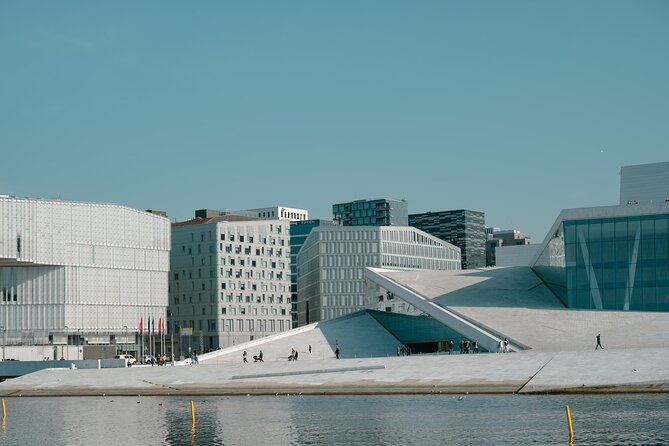
From the waterfront, the walk enters Kvadraturen, Oslo’s old city quarter, and pauses at Christiania Square for about seven minutes. This is one of the places where the route shifts from modern harbor development to older urban Oslo.
The name Christiania recalls an earlier name for the city, and the square helps frame the city’s past before the tour moves on. You are not simply ticking off famous buildings. You are seeing how Oslo’s center changes from one period to another within a short walk.
This stop may appeal most to you if you like city structure and small historical clues. The tour does not promise a long architectural study, so keep your expectations measured. The value is in the connection between the old quarter and the next major stop, Akershus Fortress.
Akershus Fortress and Alfred Nobel
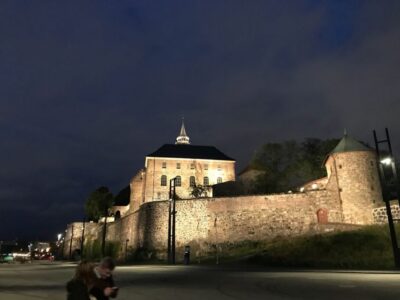
Akershus Castle and Fortress receives about eight minutes. It is the clearest historic setting on the route and one of the strongest reasons to choose this walk over a simple stroll along Karl Johans gate.
The fortress gives you a chance to hear about Oslo’s defensive past while looking across the harbor from elevated ground. The guide also tells the story of Alfred Nobel here, linking the fortress area to the Nobel Peace Center later in the walk.
The view is important. One response from the tour company specifically referred to beautiful scenery and views from the top of the fortress. Even with a short stop, this is likely the place where you get the most visual variety: old stonework, open water, and the city spread below.
Eight minutes is enough for an introduction, not a full visit. You will not have time to explore every corner of the grounds or enter every attraction. If castles are your main interest, return separately. For a first orientation, the stop gives the route a solid historical center.
Same base, a completely different day:
- Oslo: Scenic Fjord Cruise with Audio Guide Commentary
★ 4.5 · 5,375 reviews - Oslo: 100% Electric Oslofjord Sightseeing Cruise
★ 4.4 · 2,041 reviews - Oslo: Fjord Evening Cruise with Shrimp Buffet
★ 4.5 · 1,956 reviews - Oslo: 3-Hour Highlights Bike Tour
★ 4.8 · 1,609 reviews
Aker Brygge, the National Museum, and the Nobel Peace Center
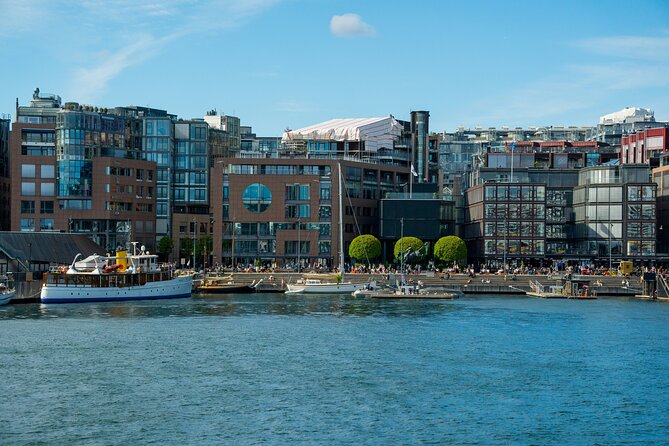
The walk continues toward Aker Brygge, with about seven minutes for the area and nearby attractions. The National Museum and Nobel Peace Center are included in the discussion, along with the waterfront district itself.
Aker Brygge gives you another view of modern Oslo. After the old fortress, you are back among public spaces, restaurants, museums, and the harbor. The guide’s role here is to connect the city’s cultural institutions with the way people use the center today.
The Nobel Peace Center fits neatly with the Alfred Nobel story introduced at Akershus. It also gives the guide a chance to explain Norway’s role in the peace prize and international public life. You should not expect entry to the center, since the tour is conducted outside and admission is not listed for this stop.
This is a good place to note museums you may want to visit later. The route offers names and context, but the short schedule means you will not get a full explanation of each collection. I would use this portion as a planning aid: mark the National Museum or Nobel Peace Center for another day if one catches your interest.
City Hall and Oslo’s public face
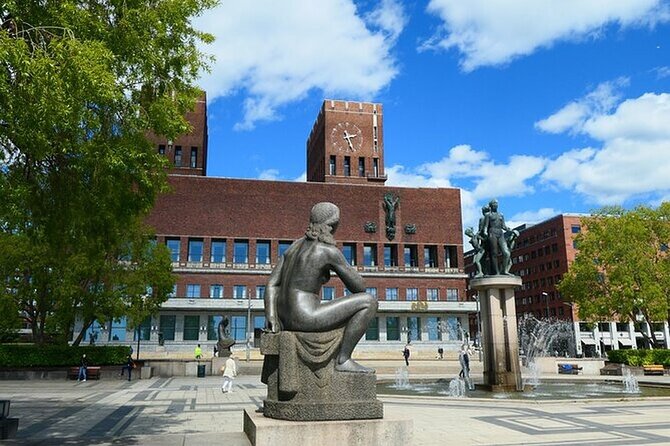
Oslo City Hall, or Rådhuset, gets about ten minutes, making it one of the longer stops. That extra time matters because the building carries several themes at once: municipal government, public art, the Nobel Peace Prize ceremony, and the city’s waterfront setting.
This is a good stop for understanding how Oslo presents itself. The tour’s focus is not only royal buildings and old stone walls. City Hall adds the working civic side of Norway, and the guide can place national traditions beside ordinary public life.
You may find this part especially useful if you want more than postcard views. A short explanation of City Hall can help you understand why the building matters before you return on your own. As elsewhere, the value depends on the guide’s storytelling. The best guides appear to keep the facts moving with humor and local detail rather than reciting dates.
Nationaltheatret and Henrik Ibsen
The route then reaches Nationaltheatret, with about six minutes devoted to the theater and Henrik Ibsen. This is a compact stop, but it adds literature and performance to the tour’s mix of politics, art, and architecture.
Ibsen is one of Norway’s best-known writers, and the theater offers a natural setting for a brief introduction to his place in Norwegian culture. You will not receive a full literary seminar in six minutes. Instead, expect a useful explanation of why the theater and writer belong on a city-center walk.
This section also helps break up the sequence of government buildings. If you enjoy books, theater, or cultural figures, listen closely here. If you prefer monuments and views, it is a shorter stop and will not slow the walk much.
University Aula and Munch’s painted walls
The University Aula receives about four minutes. That is the shortest timed stop, but the detail connected with Edvard Munch makes it worth noticing.
The Aula is associated with paintings by Munch, and the guide uses the site to tie the artist back to the city you have already encountered near the Opera House and Munch Museum. This gives the route a thread: Munch is not treated as an isolated museum name, but as part of Oslo’s public and cultural story.
Because the stop is brief, you should not expect an extended look at the artwork. The point is to know what is here and why it matters. If Munch is a priority for you, plan a separate museum visit rather than relying on this walking tour alone.
The Royal Palace and Norwegian royal stories
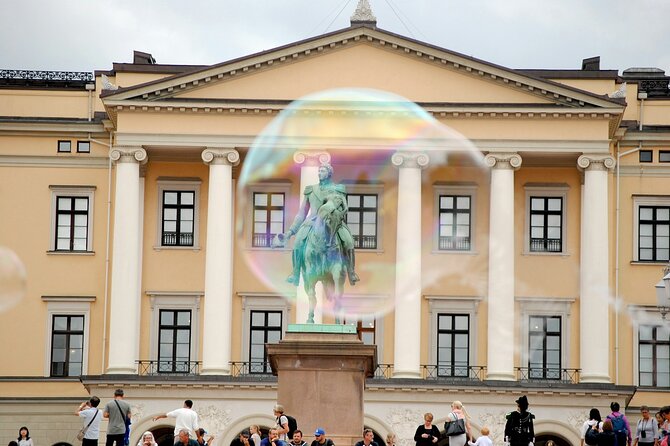
The Royal Palace receives about eight minutes. This is one of the route’s most familiar sights, but the guide’s stories about the Norwegian Royal Family are what make the stop useful.
The palace introduces the constitutional and ceremonial side of Norway after the tour has already shown you the fortress, City Hall, theater, and university. You get a better sense of how the city’s major institutions sit close together along the central route.
This is also the kind of stop where a personal guide makes a difference. Royal history can become a list of names and dates, or it can turn into a readable explanation of how the family fits into modern Norwegian life. The praise given to guides such as Zoe, Nicholas, Nikola, Yellena, and Mia suggests that friendliness and storytelling are central to the experience, though the exact style will vary.
The stop is outside. The tour does not include a palace interior visit or a formal royal ceremony, so save those expectations for another activity.
Ending at the Norwegian Parliament
The final stop is the Norwegian Parliament, at Karl Johans gate 22. The tour ends here after about eight minutes, giving you a natural finish among Norway’s political institutions.
This is a sensible endpoint. You have moved from the station and waterfront through history, culture, royalty, and civic life, then finished at the country’s legislature. The walk ends about ten minutes from the Tiger statue, so you can return to the station without much trouble.
Ending near Parliament also gives you a useful base for the rest of the day. You are already on or near Oslo’s main central avenue, with the palace and theater district behind you. If you want lunch, more shopping, or another look at the center, you can continue on foot.
What the $3.45 price really means
At $3.45 per person, the booking price is unusually low for a guided 90-minute introduction to a capital city. The value is strongest if you want orientation, landmark context, and a list of places to revisit rather than a private guide or museum tour.
There is an important catch. One account says the same walk can be found online as a free walking tour and that a tip of about $10 per person is expected. In practical terms, do not build your budget around paying only $3.45. Check the booking terms carefully, and carry enough money for a tip if you feel the guide has earned one.
A group of up to 30 people also explains the low cost. You get a social tour with people from different countries, but you may not receive much individual attention. Stand near the guide if you want to hear every story, and ask questions during natural pauses rather than waiting until the group has moved on.
The tour uses a mobile ticket and offers free cancellation up to 24 hours before the start time. Within 24 hours, the amount paid is not refunded, and changes are not accepted. The experience also requires a minimum number of participants, so a cancellation for that reason brings an alternative date or a full refund.
Is the walking pace right for you?
The walk lasts about 90 minutes and links many stops in a compact part of Oslo. You should be comfortable walking continuously through city streets and stopping outdoors. One account praised the easy pace, while another felt there was more walking than talking. Both points are useful.
If you want a gentle overview with regular stories, the route may suit you well. If you expect a detailed lecture at every building, the schedule will feel compressed. Guides must cover the Opera House, old quarter, fortress, waterfront, City Hall, theater, university, palace, and Parliament in a short time.
The tour is listed as suitable for most people, and service animals are allowed. It is near public transportation, which helps with arrival and departure. Weather matters, though. One account specifically noted chilly wind, even while praising the guide’s calm pace, so bring a layer when the forecast looks cool.
Who should book this Oslo walk?
I would choose this tour for a first morning or afternoon in Oslo, especially if you want a clear sense of the center before deciding which museums deserve your time. It suits solo visitors, couples, families with older children, and anyone who prefers stories to a self-guided route.
It is also a good match for a short stay. You cover the main central sights without committing half a day, and the route gives you several ideas for later: the Munch Museum, National Museum, Nobel Peace Center, Akershus Fortress, and Opera House.
I would look elsewhere if you want a small private group, long stops inside museums, or a detailed academic account of Oslo’s past. The group may reach 30 people, the stops are short, and the walk stays focused on the center. The occasional three-star account also shows that the experience can feel too quick or too light if the guide speaks fast or if you hoped for more historical detail.
Final call: a useful first look at Oslo
Book this walk if you want a friendly central overview, clear orientation, and stories about Norwegian royalty, art, politics, and daily life. Its best features are the efficient route, the fortress views, the wide mix of sights, and guides such as Zoe, Nicholas, Nikola, Yellena, and Mia who are described as personable and entertaining.
Go in knowing that the tour is not entirely free in the everyday sense if a tip is expected, and that 90 minutes allows only a short introduction at each stop. Arrive ready to walk, listen for the details that interest you, and use the tour as a starting point for exploring Oslo on your own.
FAQ
How long does the Free City Walking Tour in Oslo last?
The tour lasts about 1 hour and 30 minutes.
Where does the tour start?
It starts at The Tiger sculpture at Jernbanetorget, 0154 Oslo, near Oslo Central Station.
Where does the tour end?
It ends at the Norwegian Parliament, Karl Johans gate 22, 0026 Oslo. The endpoint is about a ten-minute walk from the Tiger statue.
What sights are included?
The route includes the Oslo Opera House, Public Library, Munch Museum area, Bjørvika, Sørenga, Kvadraturen, Christiania Square, Akershus Fortress, Aker Brygge, the National Museum, Nobel Peace Center, City Hall, Nationaltheatret, University Aula, Royal Palace, and Norwegian Parliament.
How many people can join the tour?
The maximum group size is 30 people.
Can I cancel the tour for a full refund?
Yes. You can cancel at least 24 hours before the start time for a full refund. Cancellations or changes made within 24 hours are not refunded or accepted.
Just added around Oslo
- 4 hours Best View of the Oslofjord Winter Edition★ 4.0 · 15 reviews
- Unknown war. Oslo and Norway during 1940-45★ 5.0 · 74 reviews
- The Ultimate Norwegian Skiing Experience★ 5.0 · 16 reviews
- Oslo Winter Highlights Bike Tour★ 5.0 · 36 reviews
- Visit the Instaworthy Spots of Oslo’s Vigeland Park with a Local★ 5.0 · 4 reviews
- The Viking Planet Museum – Mini Group (4 adults)★ 4.0 · 16 reviews
- The Ultimate Study of the Human Form at Vigeland’s Sculpture Park with a Local★ 4.0 · 14 reviews
- Fjord Houseboat Cruise in Oslo. 100 % electric. BYO★ 5.0 · 3 reviews
Walking Tours, compared.

Past & Present Small Group Guided Walking Tour
Read our review →
Walking Tour in Bergen of the Past and Present
Read our review →
Browse the lists this tour appears in