

Reviewed · WALKING TOURS
Hipstoric Grünerløkka Private Walking Tour
Oslo’s most interesting face appears when you leave the grand waterfront sights behind. This private walk leads you from political Youngstorget through old working-class streets, riverside paths, street art zones, wooden homes, medieval churches, and the food hall at Mathallen. It is a good way to see how ordinary neighborhoods became part of modern Oslo.
I like two things here. First, the route has real variety: you move from public squares to the Akerselva River, then from graffiti-covered industrial buildings to quiet cemeteries and colorful wooden houses. Second, the private format lets your guide shape the conversation. Inger and Björn have both been praised for explaining Oslo’s culture and past clearly, including details you might miss on your own.
The main consideration is the price, $237.12 per person. That is a serious cost for a three-hour walk, especially for one or two people. It makes more sense for a small group that values a private guide, or for first-time visitors who want a focused introduction to Grünerløkka rather than a standard city-center tour.
What makes this Oslo walk worth considering
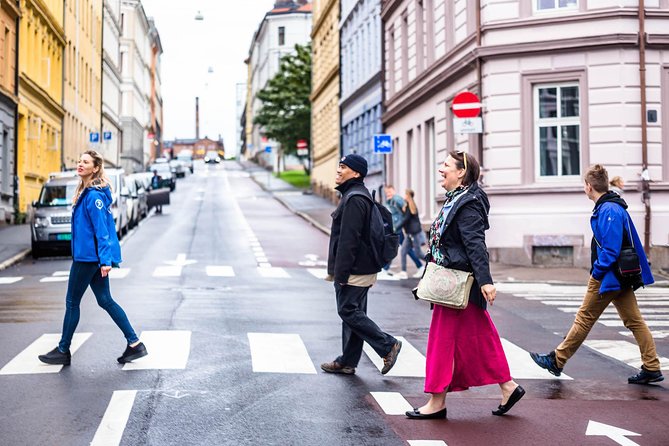
- Thirteen stops in three hours: The route covers political Oslo, local streets, art spaces, churches, cemeteries, parks, and a food hall.
- A private English-speaking guide: Your group tours alone, with guides such as Inger and Björn praised for clear explanations and local insight.
- A changing view of Grünerløkka: You see its working-class roots, later gentrification, music venues, street art, and everyday residential streets.
- Strong connections to Norwegian art: Olaf Ryes plass, Damstredet, Telthusbakken, and Our Saviour’s Memorial Cemetery all connect to Oslo’s artistic past.
- A practical finish at Mathallen: You end near one of Oslo’s main food halls, with time to eat or continue exploring Vulkan.
- A walk for reasonably fit visitors: The route includes about three hours on foot and operates in all weather, so good shoes and suitable clothing matter.
From Youngstorget to the city’s political heart
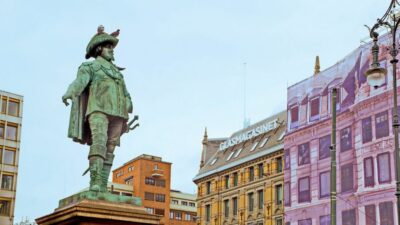
The tour begins at Youngstorget, a square that says a lot about Norway’s public life. Political speeches and rallies take place here, including the women’s march on March 8 and gay pride events. Its location near Oslo’s government quarter also explains why political organizations have offices nearby.
Your guide can use this first stop to place the rest of the walk in context. You are not starting with a postcard view. You are starting with a working public square, a place where national issues become visible in the street.
The stop lasts about 10 minutes, and admission is free. Since this is a meeting point rather than a formal attraction, the value comes from the guide’s explanation and the chance to understand the city before the walk moves into neighborhood streets.
Next comes Torggata, whose name means Square Street. It is also represented in the Norwegian edition of Monopoly, a small detail that gives the street a playful place in local culture. You should not expect a long sightseeing stop here. Instead, it helps connect Youngstorget with the older commercial routes leading toward the river.
Other guided walks in Oslo:
- Oslo Nature Walks: Island Hopping Tour
★ 4.8 · 2,713 reviews - Oslo Nature Walks: Island hopping
★ 5.0 · 570 reviews - Oslo: Best of Oslo Walking Tour
★ 4.5 · 458 reviews
Torggata and Kulturkirken Jakob
Kulturkirken Jakob gives the route a distinctly Oslo feel. This former church is used by Kirkelig Kulturverksted for theatre, concerts, dance, and other cultural events. It is one of the few churches in Norway devoted to this kind of cultural programming.
The point is not simply to admire a church exterior. You get a glimpse of how an older religious building can serve a new public role. The stop lasts about 10 minutes, and the schedule may not include an event or interior visit, so think of this as a cultural-history stop rather than a concert outing.
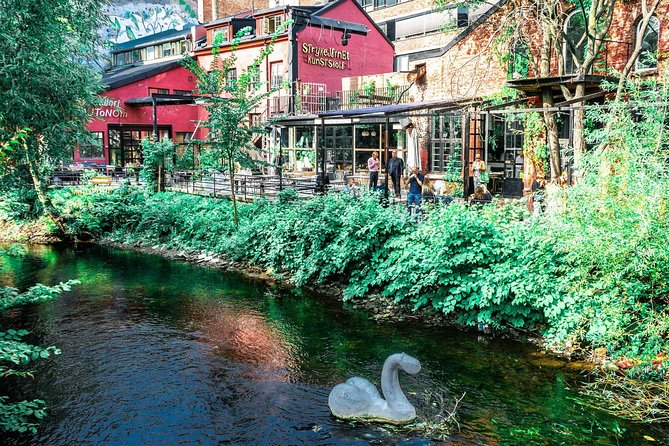
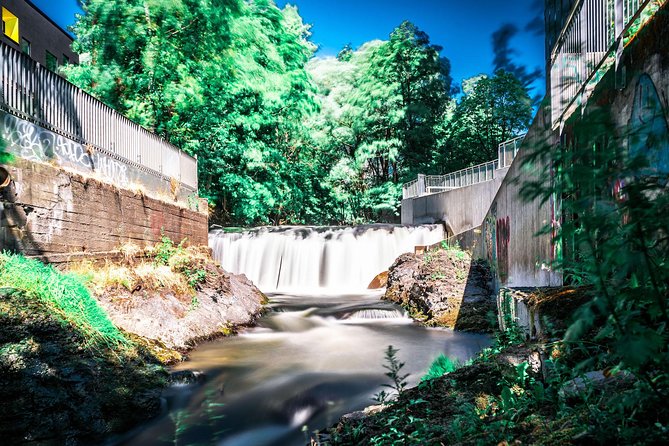
From here, the walk heads toward the Akerselva River. The river is known as Oslo’s green lung because parks and walking paths follow its course. This is one of the route’s best changes of pace. Streets and buildings give way to water, trees, and a more open setting.
You cross the river by the Fairytale Bridge and enter Grünerløkka. The bridge marks more than a scenic crossing. It signals your arrival in a district that was traditionally working class and later changed through gentrification during the late 1900s.
Grünerløkka, Olaf Ryes plass, and local character
Grünerløkka is the center of the tour, and the route gives you more than a quick café-and-boutique view. Your guide explains how the neighborhood shifted from an industrial and working-class district into one of Oslo’s best-known arts and culture areas.
At Olaf Ryes plass, you see three- and four-story buildings dating mainly from the late 1800s. The park is also linked with Edvard Munch, who lived in one of the surrounding buildings as a young man. Nearby Parkteatret is now one of Oslo’s well-known concert venues, adding a current music connection to the older residential setting.
The stop takes about 10 minutes. I like this part because it lets you read the neighborhood through its buildings. The park, old apartments, Munch connection, and concert venue all sit close together, giving you a compact view of Grünerløkka’s past and present.
Still, the route does not offer a long pause for shopping, sitting, or café time. If you want to browse stores or stop for coffee, you may need to return later. The focus here is guided context, not free time.
Blå and Brenneriveien: Oslo’s street art side
The walk continues to Blå, an alternative music venue beside the Akerselva. The surrounding area is one of Oslo’s main spots for street art. Bring your camera, since this is one of the most visual parts of the route.
Street art can change quickly, and the exact works you see may not remain the same. That is part of the appeal, but it also means you should treat the stop as a look at Oslo’s creative scene rather than a fixed outdoor museum.
At Brenneriveien, old unused industrial buildings have been turned into a street art area by local art students. This stop gives the route a rougher edge than the historic squares and parks. You see how former industrial space can become a platform for new work without being polished into a formal gallery.
The two stops together explain why Grünerløkka appeals to people who want more than Oslo’s central monuments. You get music, student art, old factories, and public walls. The drawback is practical: street art areas may feel uneven or less tidy than the city’s main sightseeing zones, and the tour operates outdoors in all weather.
Same base, a completely different day:
- Oslo: Scenic Fjord Cruise with Audio Guide Commentary
★ 4.5 · 5,375 reviews - Oslo: 100% Electric Oslofjord Sightseeing Cruise
★ 4.4 · 2,041 reviews - Oslo: Fjord Evening Cruise with Shrimp Buffet
★ 4.5 · 1,956 reviews - Oslo: 3-Hour Highlights Bike Tour
★ 4.8 · 1,609 reviews
Damstredet and Oslo’s old wooden homes
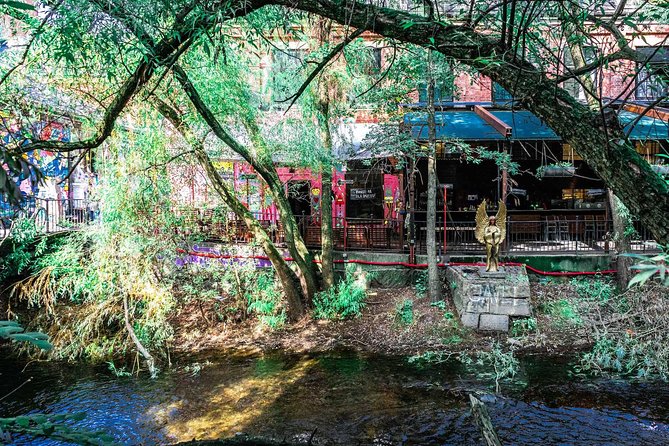
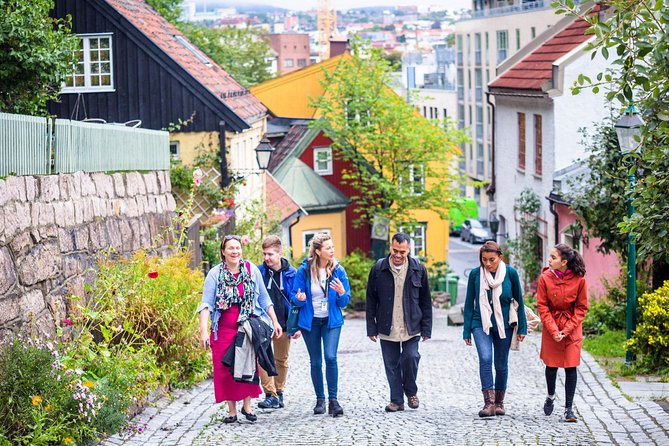
Damstredet changes the mood again. Its old wooden houses are preserved and still inhabited, and the hillside setting makes it one of the route’s best photo stops.
These are not reconstructed buildings in a museum park. People live here, so the guide’s role is especially useful. You can appreciate the colorful homes while remembering that this is a residential street, not a staged attraction. Keep your voice down and avoid treating private doorways as props.
The stop takes about 10 minutes. It is short, but the contrast with Brenneriveien is strong. Within the same general part of Oslo, you move from industrial walls and student art to quiet timber houses on a slope.
For photographers, this is one of the most useful portions of the walk. For anyone with limited mobility, the hillside setting and the overall length of the tour deserve attention. The tour calls for a moderate level of physical fitness, and comfortable shoes are a sensible choice.
Ibsen, Munch, and the oldest church in Oslo
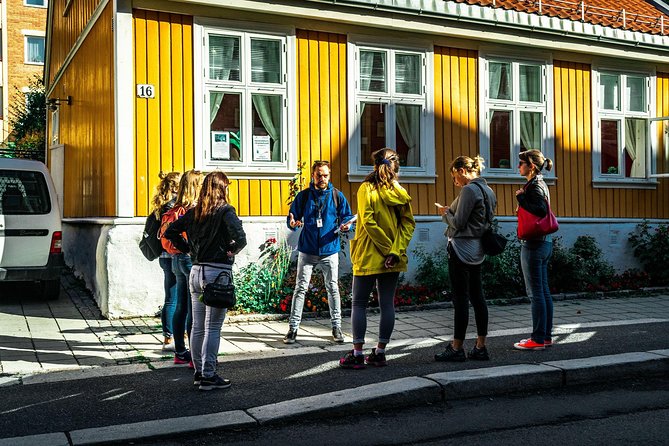
Our Saviour’s Memorial Cemetery is another important stop, lasting about 15 minutes. The cemetery is the resting place of famous Norwegians, including playwright Henrik Ibsen and painter Edvard Munch.
This stop gives the tour a stronger literary and artistic thread. Earlier, you saw places connected with Munch’s youth. Here, the route connects him with the city’s wider cultural memory. The cemetery is also a quiet place to pause after the busier street art sections.
Next comes Old Aker Church, or Gamle Aker Kirke. It is Oslo’s oldest remaining building and the city’s only remaining church from the Middle Ages. You should not expect a full museum visit or a long interior tour based on the stated schedule. The stop lasts about 10 minutes, so the main benefit is seeing the building and hearing its place in Oslo’s story.
I especially like the way these stops prevent the tour from becoming only a modern-neighborhood walk. The route includes culture that is current, but it also reaches back to medieval Oslo and the city’s major writers and artists.
Telthusbakken and a view from Munch’s Oslo
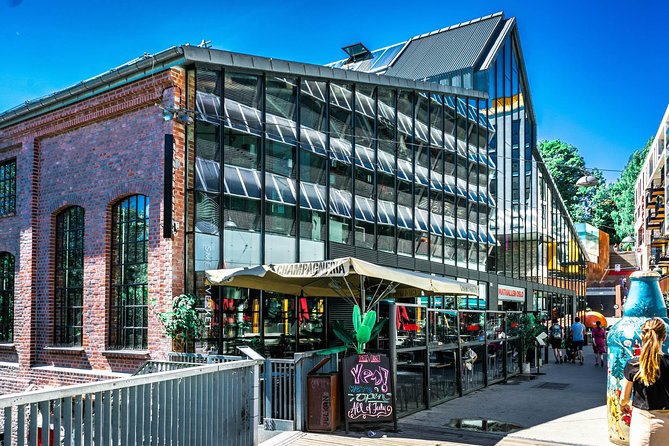
Telthusbakken is another colorful wooden street, and it is linked to one of Edvard Munch’s paintings. One side of the street has homes, while the other has allotment gardens, with around 50 people living along the residential side.
This is a fine example of the tour’s strength. You are not only shown a famous name. You see a small piece of the setting associated with that name, along with a living neighborhood that still has gardens and homes.
The street makes a strong photo stop, but be considerate. It is still a place where people live. As with Damstredet, the charm comes from the fact that the area is inhabited rather than built solely for sightseeing.
The route’s repeated Munch connections are useful if you have an interest in Norwegian art. If Munch is not a priority, your guide still has plenty of other themes to work with, including neighborhood change, architecture, politics, religion, music, and street art.
Finishing at Vulkan and Mathallen Oslo
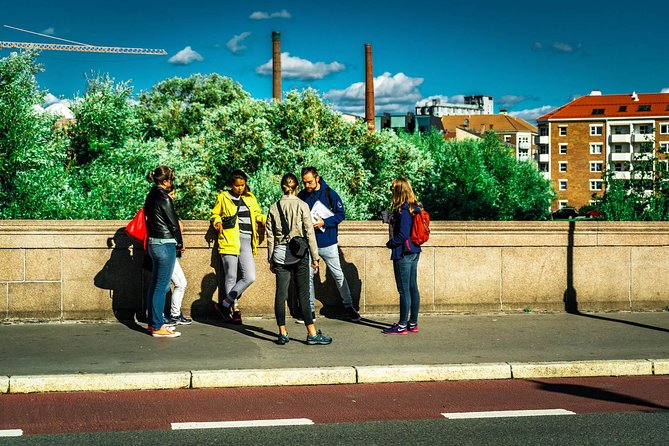
The final stop is Mathallen Oslo at Vulkan, beside the Akerselva. This former industrial river area has been redeveloped into a new city district, and Mathallen is one of Oslo’s main food halls.
Ending here is practical. After about three hours of walking, you can choose food instead of being dropped at another anonymous street corner. The hall offers options for different tastes, so it is an easy place to continue the day.
Mathallen is closed on Mondays. That does not necessarily prevent the walking tour from operating, but it does mean you should not plan your post-tour meal there on that day. The tour ends at Vulkan in Grünerløkka, and you can continue exploring the district afterward.
From the finish, you make your own way back. Walking to the original starting point takes about 15 minutes, or 1 kilometer. Public transport is also available, but the ticket is not included.
Is $237.12 per person a fair price?
At $237.12 per person, this is not a budget walk. All stops have free admission, so you are paying for the private guide, the route design, and the attention given to your group rather than for tickets.
The value improves when several people share the booking, especially since group discounts are available. A private tour can also make sense for a family or group with specific interests. You can ask about Munch, street art, political history, churches, or local life as you go, rather than follow a fixed group conversation.
For one person or a couple on a tight budget, the cost is harder to justify. You could visit parts of Grünerløkka independently, especially the river, parks, streets, and public areas. The guide is most valuable if you want the connections explained and prefer not to spend time planning the route yourself.
The tour has received a top rating from four recorded reviews. The strongest praise centers on the guides, especially Inger’s passion and ability to answer questions, and Björn’s clear explanations. That small number of reviews means I would not treat the rating as a guarantee, but the repeated theme is useful: the quality of this experience depends heavily on the person leading it.
Who should book this walk?
I would choose this tour if you have already seen Oslo’s most famous central sights and want a more local, arts-focused route. It also suits a first visit if your main interests are neighborhood life, public art, architecture, Norwegian culture, and Munch.
You should be comfortable walking for roughly three hours and dressing for changing weather. The tour runs in all weather conditions, and the route includes streets, parks, river paths, hillside areas, and cemetery grounds.
This is not the best choice if you want a relaxed café crawl, a museum tour, or a walk with lots of free time. It is also less appealing on a Monday if you are counting on finishing inside Mathallen, since the food hall is closed then.
Should you book the Hipstoric Grünerløkka tour?
Book it if you want Oslo explained through its neighborhoods rather than presented as a checklist of monuments. The route covers an unusual amount of ground in three hours, and the shift from Youngstorget’s political life to Grünerløkka’s street art, wooden houses, medieval church, and food hall gives you a fuller sense of the city.
I would book this most confidently for a small group that can share the cost and wants a private conversation with a guide. Ask for a guide such as Inger or Björn if that option is available, since their ability to explain local culture is a key part of the experience.
If the price feels too high, explore Grünerløkka independently and spend your money at Mathallen instead. But if you want the city’s scattered stories joined together, this private walk offers a useful and memorable route beyond central Oslo.
FAQ
How long is the Hipstoric Grünerløkka Private Walking Tour?
The tour lasts approximately three hours.
Where does the tour begin?
It begins at Youngstorget in Oslo, Norway.
Where does the tour end?
It ends at Mathallen Oslo, Vulkan 5, in the Grünerløkka district.
Is the tour private?
Yes. Only your group participates in the activity.
Is the tour offered in English?
Yes. English is the stated tour language.
What happens if I need to cancel?
You can cancel for a full refund up to 24 hours before the experience start time. Cancellations or changes made less than 24 hours before the start are not refunded or accepted.
Just added around Oslo
- 4 hours Best View of the Oslofjord Winter Edition★ 4.0 · 15 reviews
- Unknown war. Oslo and Norway during 1940-45★ 5.0 · 74 reviews
- The Ultimate Norwegian Skiing Experience★ 5.0 · 16 reviews
- Oslo Winter Highlights Bike Tour★ 5.0 · 36 reviews
- Visit the Instaworthy Spots of Oslo’s Vigeland Park with a Local★ 5.0 · 4 reviews
- The Viking Planet Museum – Mini Group (4 adults)★ 4.0 · 16 reviews
- The Ultimate Study of the Human Form at Vigeland’s Sculpture Park with a Local★ 4.0 · 14 reviews
- Fjord Houseboat Cruise in Oslo. 100 % electric. BYO★ 5.0 · 3 reviews
Walking Tours, compared.
Past & Present Small Group Guided Walking Tour
Read our review →
Walking Tour in Bergen of the Past and Present
Read our review →
Browse the lists this tour appears in