
Reviewed · WALKING TOURS
Oslo City Walks – The City of Contrasts
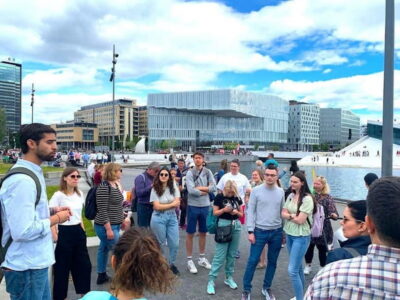
Oslo’s best story is its sharp change of character. In about two hours, this walk connects the city’s polished new waterfront with old Kvadraturen, showing how a former port area is becoming a cultural center. I like the Opera House roof walk and the clear focus on how modern Oslo grew around older streets. I also like the small group limit of 20, which gives you a better chance to hear the guide.
The main drawback is that the tour is short and mostly outdoors. The Munch museum ticket is not included, and a roof visit at the Opera House depends on available time. Still, the $53.31 price can make sense if you want a guided introduction rather than a quick solo stroll.
Key points to know before you book
- The route links new and old Oslo: You move from Bjørvika’s modern waterfront to historic Kvadraturen.
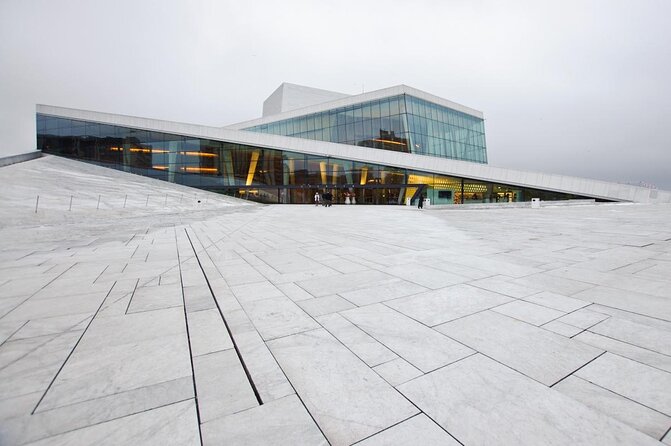
- The Opera House is the visual highlight: If time allows, you can walk on its sloping roof at no extra charge.
- Munch is an exterior stop unless you pay separately: The museum ticket is not included in the tour price.
- The walk takes about two hours: It begins at 5:00 pm and finishes near Deichman Bjørvika.
- The group is capped at 20 people: That is a useful limit for a city walk with frequent stops.
- Bad weather does not cancel the outing: Dress for Oslo’s conditions and wear practical shoes.
Why this two-hour walk makes sense in Oslo
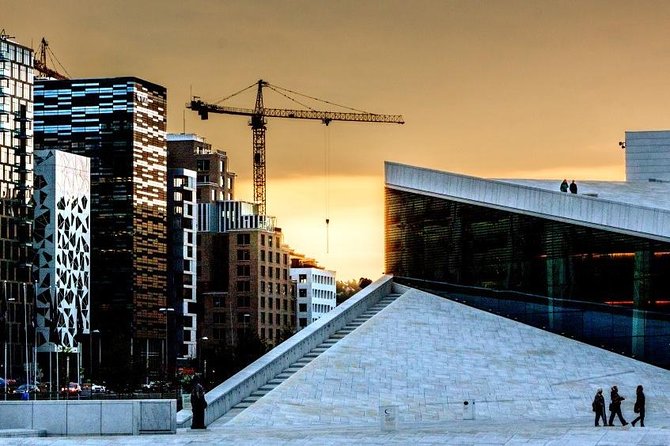
Oslo can feel confusing on a first visit. The city has old streets, new architecture, waterfront construction, museums, bridges, and neighborhoods with very different personalities. This walk gives you a simple thread to follow: Oslo as a city of contrasts.
The route begins at Oslo Visitor Center beside Jernbanetorget, a handy meeting point near public transportation. From there, the guide leads you toward Bjørvika, the former container-port area that is now one of the city’s most important cultural zones.
I like this approach because it does not treat Oslo as a collection of disconnected sights. The point is to see how the city is changing. You will look at architecture, public spaces, transport links, and older civic areas as parts of one story.
The tour is offered in English and lasts around two hours. That is enough time for an overview, but not enough for long museum visits or a slow, detailed examination of every building. Think of it as a well-organized introduction that helps you decide where to return later.
Other guided walks in Oslo:
- Oslo Nature Walks: Island Hopping Tour
★ 4.8 · 2,713 reviews - Oslo Nature Walks: Island hopping
★ 5.0 · 570 reviews - Oslo: Best of Oslo Walking Tour
★ 4.5 · 458 reviews
Starting at the Opera House
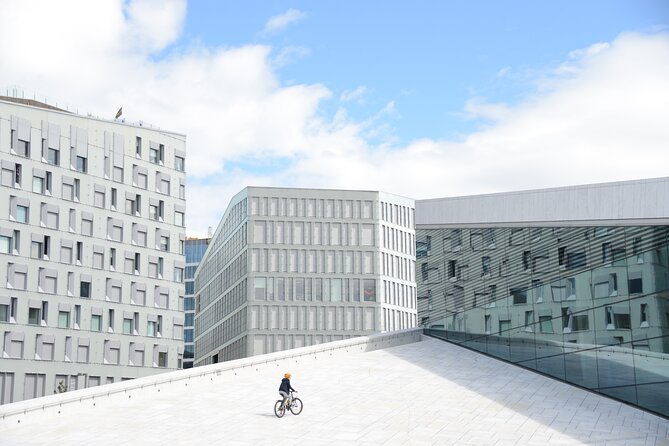
The Norwegian National Opera & Ballet is the first major stop, and it makes a strong opening. Its broad, white exterior rises in angled planes from the waterfront. The building was designed so you can walk up onto the roof, turning architecture into a public space rather than something you only view from the street.
If time allows, your guide takes you onto the roof. Admission is free, so this is one of the best-value parts of the walk. From the sloping surface, you can look across the harbor and see how much of Oslo’s newer development is concentrated around Bjørvika.
The roof can also help you understand the building itself. From ground level, it looks like a dramatic piece of modern design. From above, you experience how the architects made the building part of the city. That is more useful than simply taking a photograph in front of it.
There is one practical limitation: the roof visit is not guaranteed. The wording is if time allows, so the guide may need to keep the group moving. If this is your main reason for booking, keep your expectations flexible.
You should also dress for an outdoor walk. The Opera House roof is exposed, and this experience operates in all weather. A waterproof layer and shoes with a steady sole will serve you better than anything formal.
Reading Bjørvika through the Munch museum
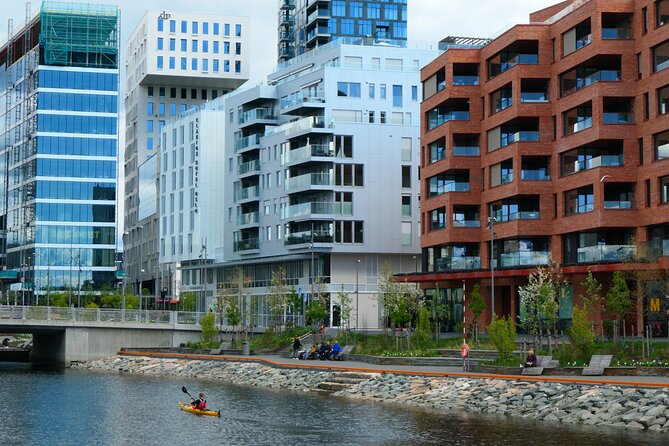
The next stop is Munch, the museum that opened in October 2021. Its arrival helped make Bjørvika a major cultural destination, and the building is part of the area’s new identity.
The tour allows around 20 minutes here. That is enough to see the building, hear why it matters, and understand its place in Oslo’s redevelopment. It is not enough for a full museum visit, especially if you want time with Edvard Munch’s paintings.
Admission to Munch is not included. This is important when comparing the tour with a self-guided day around Bjørvika. You are paying for the guide’s explanation and the walk, not for entry to the museum.
If you want to visit the galleries, plan that for another time and budget for a separate ticket. The walking tour works better as an introduction to the museum and its setting than as a substitute for going inside.
I also like the timing of this stop. After the Opera House, Munch shows a different side of Oslo’s modern design. You can compare two major cultural buildings and see how the waterfront has been reshaped around them.
The area is still presented as one of the most changing parts of Oslo. That matters because the walk is not only about finished monuments. It is also about a city deciding how to use land that once served a more industrial purpose.
Crossing Oslo on the Akrobaten Bridge
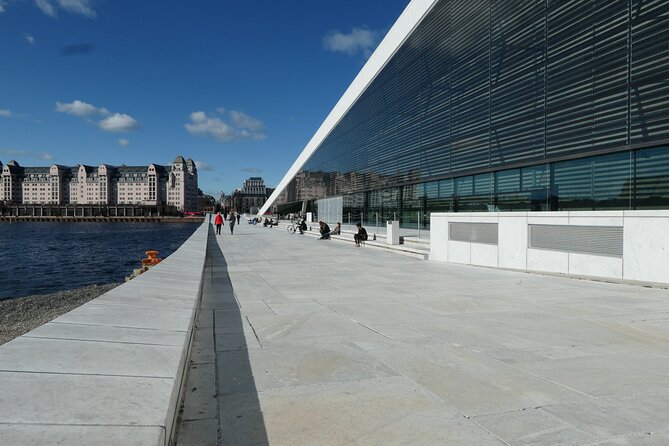
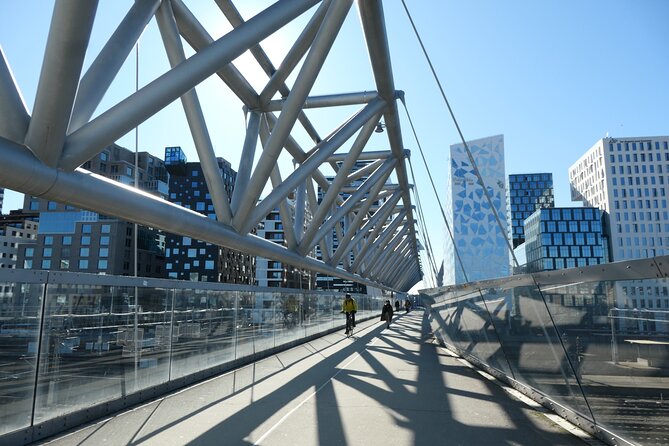
The Akrobaten Pedestrian Bridge takes about 10 minutes and connects Grønland with Bjørvika. The bridge is a practical crossing, but it has also become a recognizable feature of the city.
This stop gives the tour a change of pace. Instead of standing beside a major building, you move through the city and see how neighborhoods connect. The bridge helps explain why new Bjørvika is not an isolated waterfront project. It links to Grønland and makes the area easier to reach on foot.
For you, the value is partly visual and partly practical. A bridge crossing offers changing angles on the surrounding buildings, streets, and public spaces. It also breaks up the architecture-heavy portions of the route.
The stop is free and does not require a ticket. As with the Opera House roof, though, it is an outdoor setting. Rain and wind can affect your comfort, so the all-weather policy is worth taking seriously.
Same base, a completely different day:
- Oslo: Scenic Fjord Cruise with Audio Guide Commentary
★ 4.5 · 5,375 reviews - Oslo: 100% Electric Oslofjord Sightseeing Cruise
★ 4.4 · 2,041 reviews - Oslo: Fjord Evening Cruise with Shrimp Buffet
★ 4.5 · 1,956 reviews - Oslo: 3-Hour Highlights Bike Tour
★ 4.8 · 1,609 reviews
Finding old Oslo in Kvadraturen
The tour also visits Kvadraturen, Oslo’s older central area. The name refers to the district’s grid-like street plan, which gives it a different feel from the newer waterfront spaces.
Here, the focus shifts from modern architecture to the city’s earlier civic and social life. You see the area that includes Oslo’s oldest restaurant and what was once the original town hall. Those details give the walk a human scale. Instead of only discussing major institutions, the guide points to places where everyday city life took shape.
Kvadraturen is especially useful for first-time visitors because it adds context to Bjørvika. Without the older district, Oslo’s new architecture can seem like a collection of impressive but separate buildings. With Kvadraturen in the picture, you get a clearer sense of the city’s past and its direction.
The supplied route details give more time to the Opera House, Munch, and Akrobaten Bridge than to the Kvadraturen sights. That suggests the old district is part of the wider story rather than a long historical walking tour. If you want a detailed study of Oslo’s earliest streets, you will need more time elsewhere.
Still, this contrast is the reason the tour works. You see the city’s older foundations and its new cultural ambitions within one compact outing.
What the guide adds to the experience
The guide is the reason to pay for this walk instead of following a map on your phone. You receive local commentary in English while moving between places that can otherwise feel unrelated.
The experience is led by a local guide, but no individual guide names are provided. The available feedback gives particular praise to the guide’s enthusiasm and strong command of the subject. That matters on a route where the buildings and urban changes need explanation to become meaningful.
A good city guide should help you notice more than the obvious photo points. At the Opera House, that means explaining why the roof is open to pedestrians. At Munch, it means placing the museum in the story of Bjørvika. At Akrobaten, it means showing how a bridge binds two areas together.
The group maximum is 20 people. That is not a private tour, but it is more manageable than a large coach group. You should still expect to walk as part of a small crowd and keep pace with the guide.
The meeting time is 5:00 pm. This suits anyone who wants to spend the earlier part of the day at another museum or on a separate Oslo outing. It also gives you a useful orientation early in your stay, though the schedule leaves no flexibility for a late arrival.
Price, timing, and the value of the route
At $53.31 per person, this is not the cheapest way to see Oslo’s waterfront. You can walk around Bjørvika without paying for admission, and the Opera House roof is free. The value comes from the guide, the structure, and the historical connection between the stops.
I would consider the price fair if you want context and have only a short time in Oslo. The walk covers several areas without asking you to plan the route yourself. It also puts the modern waterfront and Kvadraturen into one clear visit.
The value is weaker if you already know central Oslo well or prefer to explore at your own pace. You will not receive hotel pickup or drop-off, and the Munch entrance fee is separate. The tour is a walk, not a package with transport or museum admission.
The total time is around two hours, with listed stops of 15 minutes at the Opera House, 20 minutes at Munch, and 10 minutes at Akrobaten Bridge. The remaining time is used to walk between locations and hear the guide’s explanations.
That pace should suit most people with moderate physical fitness. It is not designed for anyone who wants to linger for an hour at one building. Wear comfortable shoes and allow time to reach the starting point at Oslo Visitor Center.
Weather, access, and who should book
The tour runs in all weather, so your clothing can make or break the experience. Oslo’s conditions may change quickly, and the route includes exposed outdoor areas. Bring a waterproof layer and dress for walking rather than for an indoor evening event.
Service animals are allowed. The tour is near public transportation, which makes both the start and finish practical for visitors staying in different parts of Oslo.
The walk finishes at Deichman Bjørvika, the main public library at Anne-Cath. Vestlys plass. This is a useful end point in the same broader cultural district, though you should not assume that the tour returns you to the starting point.
I would recommend this experience most strongly to:
- First-time visitors who want a quick sense of Oslo’s layout
- People interested in architecture and urban change
- Anyone with a free evening and a preference for guided walking
- Visitors who want to compare modern Bjørvika with older Kvadraturen
- Museum fans who want an introduction to Munch before visiting separately
I would be more cautious if you dislike walking in poor weather, need step-free details confirmed in advance, or want a long indoor museum experience. The supplied information gives a moderate fitness requirement but does not provide a full accessibility description.
The tour offers free cancellation if you cancel at least 24 hours before the 5:00 pm start time. Changes or cancellations made less than 24 hours before the start are not refunded, and the cut-off follows Oslo local time.
Should you book Oslo City Walks?
Book it if you want a short, guided introduction to Oslo’s changing waterfront and older center. The Opera House roof, the Munch building, Akrobaten Bridge, and Kvadraturen create a sensible sequence, and the guide gives the route meaning that you may miss on your own.
Skip it if you plan to spend the whole day exploring Bjørvika independently or want entry to Munch included. The tour does not replace a museum visit, and its roof stop depends on time.
For most first visits, I see this as a useful orientation walk rather than a full Oslo experience. It gives you the city’s big contrast in a compact package: new cultural buildings beside older streets, public architecture beside working city connections, and a former port becoming a center for art and public life.
FAQ
How long does the Oslo City Walks tour last?
The walking tour lasts approximately two hours.
What time does the tour start?
The tour starts at 5:00 pm.
Where does the tour begin?
The meeting point is Oslo Visitor Center at Jernbanetorget 1, 0154 Oslo, Norway.
Where does the tour finish?
The tour ends at Deichman Bjørvika at Anne-Cath. Vestlys plass 1, 0150 Oslo, Norway.
Is admission to the Munch museum included?
No. Admission to Munch is not included in the tour price.
Does the tour operate in bad weather?
Yes. The experience operates in all weather conditions, so you should dress appropriately.
What is the cancellation policy?
You can cancel up to 24 hours before the start time for a full refund. Cancellations or changes made less than 24 hours before the start time are not accepted for a refund.
More walking tours in Oslo
- Oslo: Guided Walking Tour of Central Oslo
★ 4.7 · 438 reviews - Oslo: Historic Myths & Legends Evening Walking Tour
★ 4.8 · 408 reviews - Taste of Oslo Walking Tour
★ 4.5 · 282 reviews - Central Oslo Guided Walking Tour with Local Guide
★ 4.5 · 278 reviews
Just added around Oslo
- 4 hours Best View of the Oslofjord Winter Edition★ 4.0 · 15 reviews
- Unknown war. Oslo and Norway during 1940-45★ 5.0 · 74 reviews
- The Ultimate Norwegian Skiing Experience★ 5.0 · 16 reviews
- Oslo Winter Highlights Bike Tour★ 5.0 · 36 reviews
- Visit the Instaworthy Spots of Oslo’s Vigeland Park with a Local★ 5.0 · 4 reviews
- The Viking Planet Museum – Mini Group (4 adults)★ 4.0 · 16 reviews
- The Ultimate Study of the Human Form at Vigeland’s Sculpture Park with a Local★ 4.0 · 14 reviews
- The Oslo Beer Adventure★ 4.5 · 11 reviews
Walking Tours, compared.
Past & Present Small Group Guided Walking Tour
Read our review →
Walking Tour in Bergen of the Past and Present
Read our review →
Browse the lists this tour appears in