
Reviewed · MUSEUMS & VIKING HERITAGE
Oslo: 3-hour Highlights & Vigeland Park Private Walking Tour
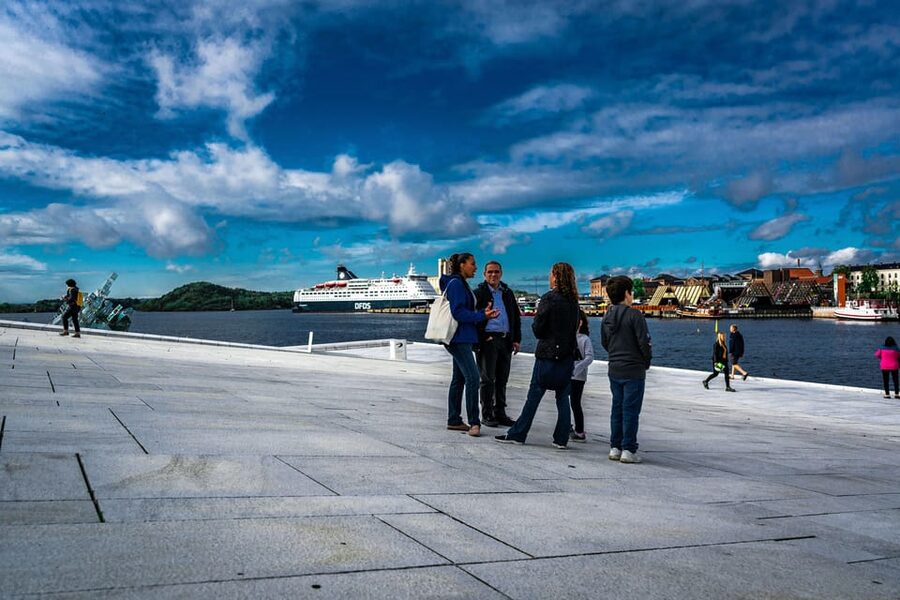
Oslo’s big visual surprise comes at the end: Vigeland Sculpture Park, where a single artist’s work fills Frogner Park with hundreds of human figures in stone and bronze. This tour gets you there after a brisk walk through the city center, so you see both Oslo’s grand public landmarks and its most unusual open-air art site in just three hours.
I like the private format, which gives you room to ask questions and shape the conversation. I also like the practical route: the guide handles the public transport leg, and the tour covers the Monolith Plateau, Akershus Fortress, the Royal Palace, City Hall, and the Nobel Peace Center without making you plan the connections yourself.
The main tradeoff is pace. Three hours is enough for highlights and orientation, not for long interior visits. You’ll also finish in Vigeland Park rather than back at the starting point, and some paths are gravel or unpaved.
Key points to know before booking
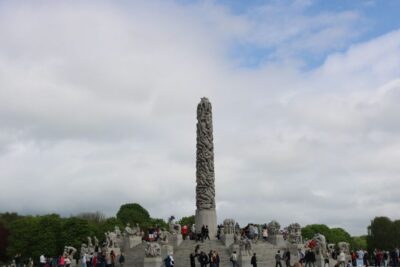
- Vigeland’s giant Monolith: See 36 carved figures arranged around the Monolith Plateau, with the central totem made from one block of stone.
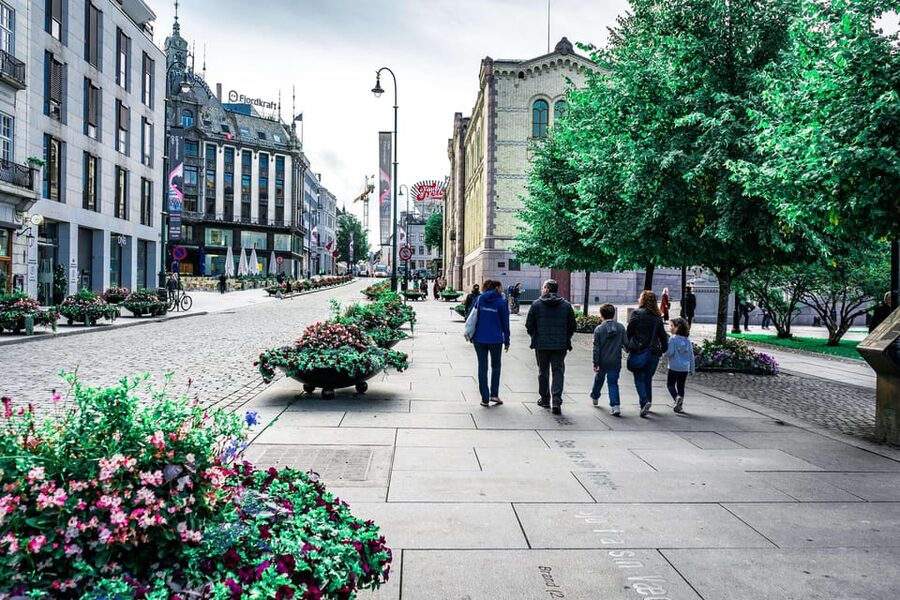
- A smart city-center route: Walk from the Nobel Peace Center past City Hall, the National Theatre, the Royal Palace, Karl Johans gate, Parliament, and Akershus Fortress.
- Private attention: Your group has its own guide, with English, Spanish, French, Italian, Norwegian, or German available.
- Public transport is built in: The guide provides a return ticket for the transport portion, though you make your own way back after the tour ends.
- A guide-led history lesson: The walk connects Alfred Nobel, Norwegian playwrights, royal power, government, and Oslo’s changing identity.
- Good shoes matter: Expect city sidewalks along with gravel and unpaved paths in the park.
Why this three-hour route works in Oslo
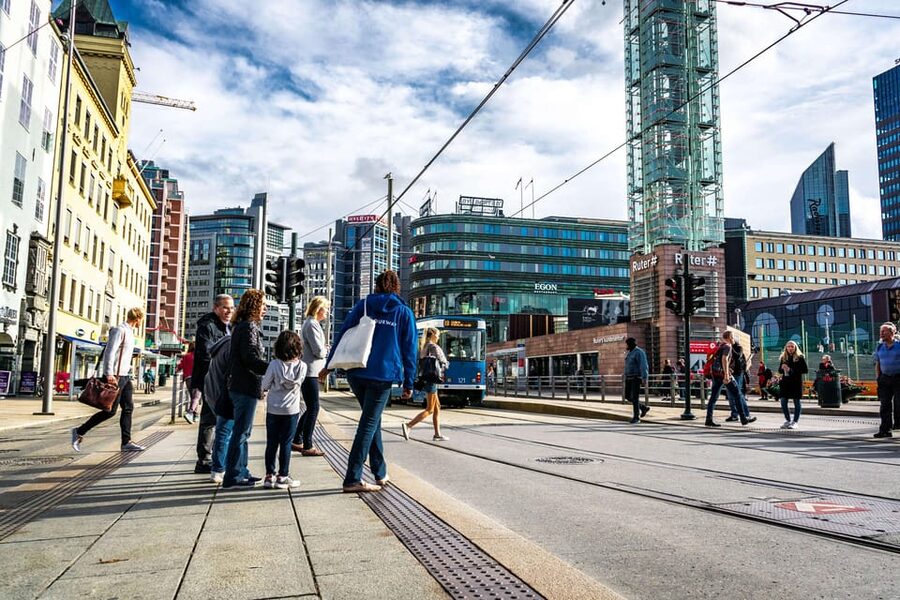
Oslo spreads its main sights across a compact center and several nearby districts. That makes a walking tour useful, but it also creates a timing problem. You can spend half a day wandering between the waterfront, the palace area, the fortress, and Frogner Park without seeing how they fit together.
This tour solves that problem with a clear split. The first 90 minutes focus on central Oslo and its public landmarks. The final hour is given to Vigeland Sculpture Park, with about 30 minutes for the move by public transport.
That balance suits a first visit. You get an introduction to Norway’s capital, then spend enough time in the park to understand why it is not simply a pleasant green space with a few statues. It is an entire artistic project built around the human body, relationships, age, work, struggle, and the cycle of life.
You should not expect full access to every major building. The stops are primarily outside sightseeing points, and the value comes from the guide’s explanations, route planning, and local context. Think of this as a strong orientation tour with a memorable art finale.
Other ways to see the whole town in Oslo:
- Oslo: 3-Hour Highlights Bike Tour
★ 4.8 · 1,609 reviews - Oslo: 24 or 48-Hour Hop-On Hop-Off Sightseeing Bus Ticket
★ 4.1 · 1,470 reviews - Oslo Highlights Bike Tour
★ 5.0 · 979 reviews
Starting at the Nobel Peace Center
The meeting point is outside the entrance to the Nobel Peace Center at Brynjulf Bulls plass 1. Your guide arrives about 10 minutes before departure and carries a sign with the local partner’s name.
This is a useful place to begin because the Nobel Peace Center gives the tour an immediate connection to Alfred Nobel and the Peace Prize. You will hear the story behind Nobel and the purpose of the center, even though the tour does not include a full museum visit.
If you are coming from a cruise ship or another part of central Oslo, allow enough time to find the exact entrance. The instructions are clear, but a large city-center meeting point can still take a few minutes to locate.
The guide is the key part of this experience. The strongest praise has focused on clear English, a personable manner, and the ability to answer questions across many subjects. That matters on a private tour, where you can ask for more detail about architecture, royal life, Norwegian customs, or the city’s past instead of simply following a fixed script.
City Hall and the public face of Oslo
From the Nobel Peace Center, the walk moves through Sentrum, Oslo’s central district. One of the first major sights is Oslo City Hall, built between 1931 and 1950.
City Hall is more than a large civic building. It is tied to the Nobel Peace Prize ceremony and occupies an important place in Oslo’s public identity. From the outside, you can appreciate its scale and bold design while the guide explains how the building fits into the city.
The route then continues toward the Norwegian National Theatre. This stop gives the history lesson a cultural angle. The theater is associated with some of Norway’s greatest playwrights, so the guide can connect the building to Norwegian literature and national culture.
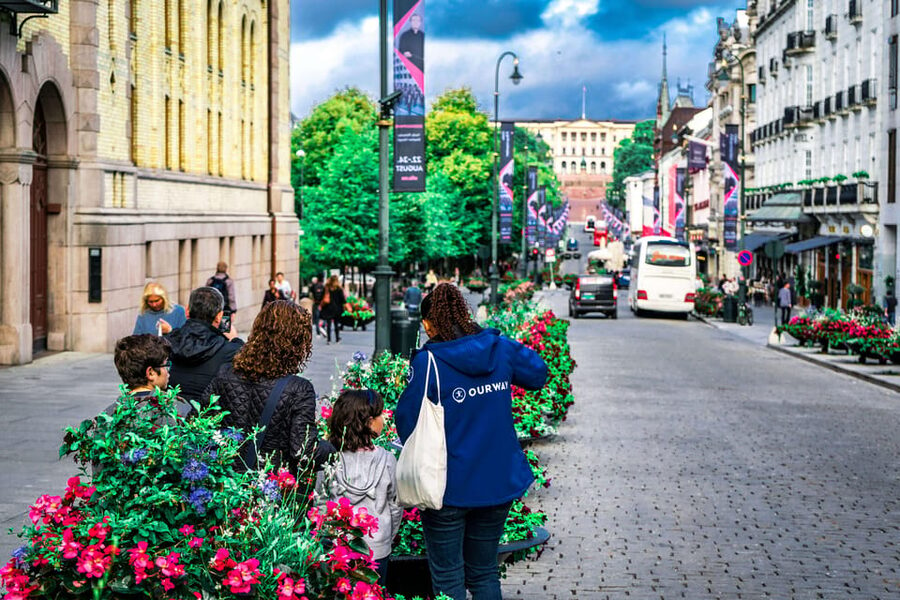
You will also pass the Royal Palace, positioned on a hill above Karl Johans gate. The setting makes the palace easy to understand as part of Oslo’s ceremonial center. From here, the pedestrian shopping street leads your eye toward the heart of the city.
The tour does not treat these buildings as isolated photo stops. It links them: the Peace Center represents international ideals, City Hall represents civic life, the National Theatre represents culture, and the palace represents the monarchy. That pattern helps you read Oslo instead of simply collecting photographs.
Karl Johans gate and Norway’s government
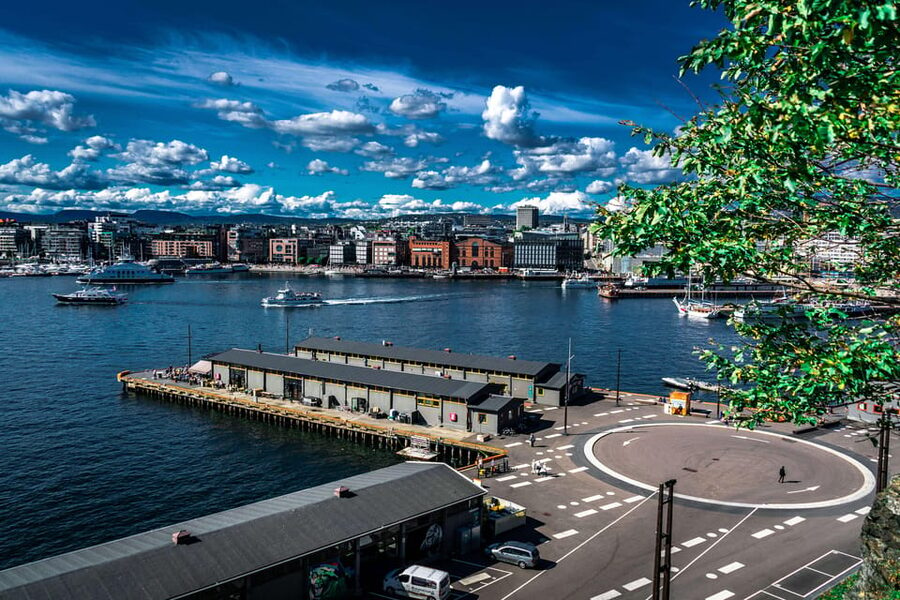
Karl Johans gate is Oslo’s main pedestrian shopping street and one of the easiest places to get a sense of the city center. The route gives you time to see the street in relation to the Royal Palace and Parliament.
The Norwegian Parliament, or Storting, provides another piece of the political story. This is where Oslo’s national government operates, and the guide explains how the country is governed.
This section should be especially useful if you want more than names and dates. The guide can help you understand the relationship between Norway’s monarchy, elected government, public institutions, and national culture. On a private tour, you can pause for questions rather than save them for later.
Still, keep your expectations realistic. The tour lists the Parliament building as a sightseeing stop, not an interior visit. You should expect to see and discuss the building from outside.
Other guided walks in Oslo:
- Oslo Nature Walks: Island Hopping Tour
★ 4.8 · 2,713 reviews - Oslo Nature Walks: Island hopping
★ 5.0 · 570 reviews - Oslo: Best of Oslo Walking Tour
★ 4.5 · 458 reviews - Oslo: Guided Walking Tour of Central Oslo
★ 4.7 · 438 reviews
Akershus Fortress above the harbor
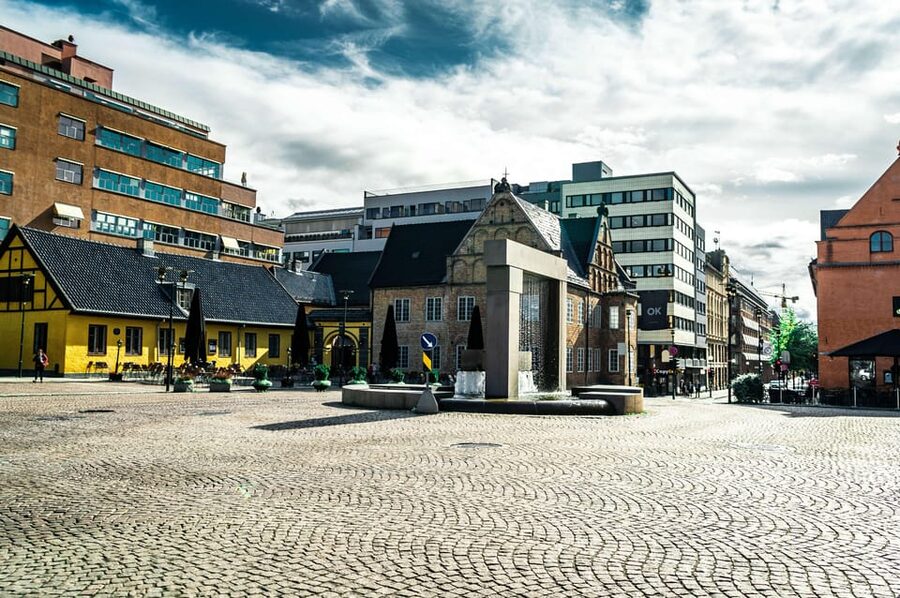
Akershus Fortress adds the oldest and most defensive note to the central walk. Set above Oslo’s harbor, it gives you a strong view across the waterfront and shows how the city’s strategic position shaped its past.
The fortress is also a good contrast to the palace and Parliament. Those buildings represent present-day ceremony and government. Akershus brings in military history, royal power, and Oslo’s earlier role as a defended harbor city.
The route includes the fortress, Bank Square, and Christiania Torv. These stops help connect modern Oslo with older layers of the city. Christiania Torv is particularly important in the story of Oslo’s earlier name and development.
The walking portion is not just a parade of famous façades. It is a compact history lesson about the capital’s changing roles. You move from international diplomacy to civic government, theater, monarchy, Parliament, defense, commerce, and older city life.
Some surfaces around historic areas may be uneven, so comfortable shoes are a must. The tour is not described as strenuous, but you should be ready to walk continuously and handle gravel or unpaved paths later in the day.
The public transport ride to Frogner Park
After the central walk, you take public transport toward Frogner Park. This part lasts about 30 minutes, and the guide provides the ticket.
That transfer is a practical advantage. You do not have to work out the route between the city center and Vigeland Sculpture Park during a tightly timed tour. Your guide can also continue the conversation during the ride, though the exact transport type and route can vary.
There is one detail to understand before booking: the tour ends in Vigeland Park. The included ticket helps with your return, but you make your own way back after the guided portion. You can continue exploring the park independently or leave by walking or public transport.
That ending is sensible for a park visit. You are not pushed immediately back into the center just because the guide’s time is finished. If you have extra energy, the park gives you more room to wander. If you are tired, check your route back before the tour ends.
Vigeland Sculpture Park and Gustav Vigeland’s work
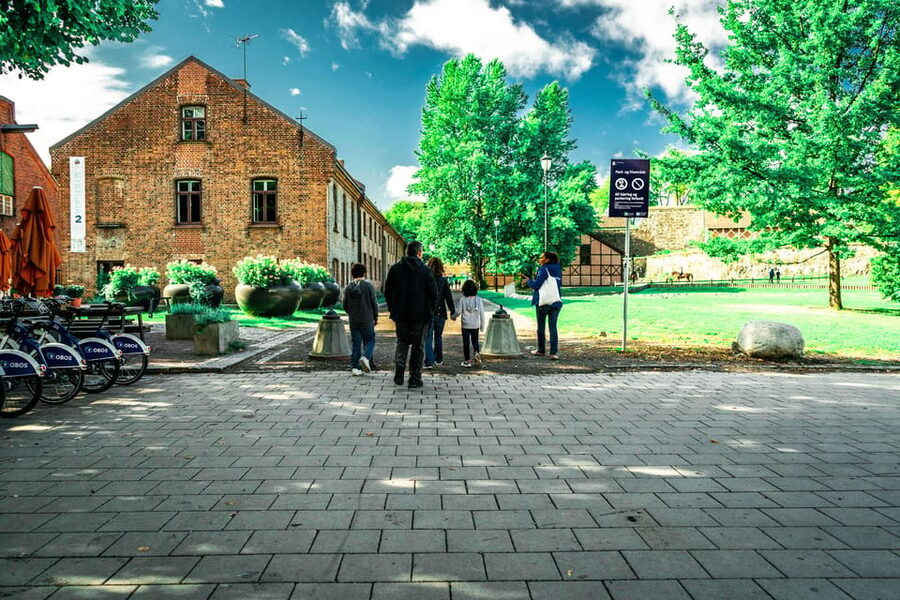
Frogner Park is the emotional high point of the tour. Here, the guide tells the story of how one man, Gustav Vigeland, created the world’s largest sculpture park devoted to the work of a single artist.
The scale is what makes the park memorable. The sculptures are not scattered decorations. They form a planned sequence of figures and groups, most made from local Iddefjord granite, and they examine the human experience through bodies, gestures, conflict, affection, age, and movement.
The tour includes the Monolith Plateau, where 36 figures are arranged around the great Monolith. The Monolith itself was carved from one enormous block of stone. Its single-piece construction gives it a force that is hard to understand from a photograph.
The figures are arranged around the central work in a way that invites you to walk, look up, and compare one group with another. Your guide can explain the themes and point out details you might otherwise miss.
This is also where the guide’s storytelling matters most. Without context, a large sculpture park can become a quick photo stop. With a good explanation, the work becomes a study of people and the stages of life. The tour gives you one focused hour, which is enough to see the major works without pretending to cover every corner of Frogner Park.
You may want more time here. That is not a flaw in the tour so much as a limit of the schedule. Since the experience ends in the park, you can stay longer after the guide leaves.
What the private format is worth
The published price is $518 per group up to one person. That is a high price for a three-hour outing if you are traveling alone, so the value depends heavily on how much you want personal attention and a fixed route.
For two or more people, a private format can make more sense if the price remains group-based, but the supplied booking information only specifies the listed group size. Confirm the final price for your party before paying.
The private setup gives you three useful advantages:
- You can ask questions throughout the walk.
- The guide can respond to your interests and pace.
- You avoid joining a large group with a fixed commentary style.
The price also includes the public transport ticket and a professional guide. Entrance to Vigeland Park is free, so you are paying mainly for the guide’s time, the private arrangement, and the convenience of combining several sights in one route.
I would consider it good value for a couple, family, or small group that wants a personal introduction to Oslo and has limited time. I would be more cautious as a solo budget visitor, especially if you are comfortable using public transport and exploring the park alone.
Who should book this Oslo tour

This tour suits a first-time visitor who wants the city’s main sights explained in a logical order. It is also a good fit for a short stay, a cruise stop, or anyone who prefers a local guide to independent research.
You will get the most from it if you enjoy history, public architecture, royal settings, and sculpture. The mix is broad enough to keep the morning or afternoon varied.
Families may appreciate the private format because children can ask questions and the group does not have to match a stranger’s pace. The sculpture park also offers strong visual interest, though the tour still involves steady walking and uneven surfaces.
This is less suitable if you want long museum visits, extensive palace interiors, or a slow café-style exploration of Oslo. It is also not the best choice if you need to finish back at the Nobel Peace Center. The endpoint is Frogner Park.
The tour is available in English, Spanish, French, Italian, Norwegian, and German. Choose the language that lets you ask questions comfortably. One of the clearest strengths reported for the experience is the guide’s ability to communicate well and answer a wide range of questions, so language fit is worth taking seriously.
Free cancellation is available up to 24 hours before departure, and you can reserve now and pay later. Starting times depend on availability.
Should you book it?
Book this tour if you want a private Oslo orientation that combines central landmarks with Vigeland’s major sculptures. The route is efficient, the transport connection saves planning time, and the final hour in Frogner Park gives the tour a distinctive finish.
Skip it if you want to enter several buildings, explore at a slow pace, or keep your spending low. You will see many important places from the outside, and you will need to arrange your own return after the park.
For a short Oslo visit, I like the way this tour handles the city. It gives you the royal, political, historic, and artistic sides in one sweep, then leaves you in a park where you can keep exploring on your own.
FAQ
Where does the tour start?
It starts outside the entrance to the Nobel Peace Center at Brynjulf Bulls plass 1 in Oslo.
Where does the tour finish?
The guided tour ends in Frogner Park, at Vigeland Sculpture Park.
How long does the tour last?
The tour lasts three hours. About 90 minutes are spent on the central Oslo walking portion, around 30 minutes on public transport, and about one hour in Vigeland Sculpture Park.
Is this a private tour?
Yes. It is offered as a private group experience.
Which languages are available?
The tour is available in English, Spanish, French, Italian, Norwegian, and German.
Is public transportation included?
Yes. The guide provides a return ticket for the public transport portion of the experience.
Do I return to the Nobel Peace Center with the guide?
No. The tour ends in Vigeland Park. Afterward, you make your own way back by walking or public transport, with tickets included and provided by the guide.
Is entry to Vigeland Park included?
Yes. Entry to Vigeland Park is free and included as part of the tour.
What should I bring?
Bring comfortable shoes and clothing suited to the weather. Some parts of the tour use gravel or unpaved walkways.
More walking tours in Oslo
- Oslo: Historic Myths & Legends Evening Walking Tour
★ 4.8 · 408 reviews - Taste of Oslo Walking Tour
★ 4.5 · 282 reviews - Central Oslo Guided Walking Tour with Local Guide
★ 4.5 · 278 reviews - Oslo: Snowy Forest Torchlight Walk with Campfire
★ 4.6 · 254 reviews
More museums around Oslo
- Kon-Tiki Museum Entrance Ticket
★ 4.5 · 1,096 reviews - Oslo: Paradox Museum Entry Ticket
★ 4.3 · 799 reviews - Oslo: Viking Planet Entry Ticket
★ 4.4 · 603 reviews - The Fram Museum Admission Ticket
★ 4.5 · 490 reviews
Just added around Oslo
- 4 hours Best View of the Oslofjord Winter Edition★ 4.0 · 15 reviews
- Unknown war. Oslo and Norway during 1940-45★ 5.0 · 74 reviews
- The Ultimate Norwegian Skiing Experience★ 5.0 · 16 reviews
- Oslo Winter Highlights Bike Tour★ 5.0 · 36 reviews
- Visit the Instaworthy Spots of Oslo’s Vigeland Park with a Local★ 5.0 · 4 reviews
- The Viking Planet Museum – Mini Group (4 adults)★ 4.0 · 16 reviews
- The Ultimate Study of the Human Form at Vigeland’s Sculpture Park with a Local★ 4.0 · 14 reviews
- Fjord Houseboat Cruise in Oslo. 100 % electric. BYO★ 5.0 · 3 reviews
Museums & Viking Heritage, compared.

Viking Village, Nærøyfjord Cruise & Flåm Railway
Read our review →

Sightseeing with Holmenkollen Ski Jump & Vigeland Park
Read our review →
Troll Museum Entry Ticket with AR Media Experience
Read our review →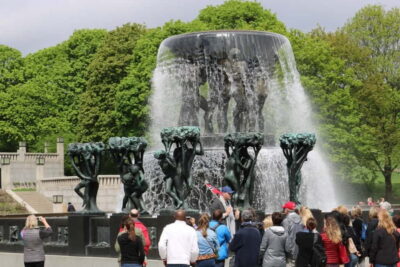
Browse the lists this tour appears in